
San Fernando Valley Real Estate: What Q1 2026 Told Us About This Market

Published on May 28, 2026 by Leegie Parker
Leegie Parker | Real Estate Advisor | DRE 01020534 | Compass | Leegie.com
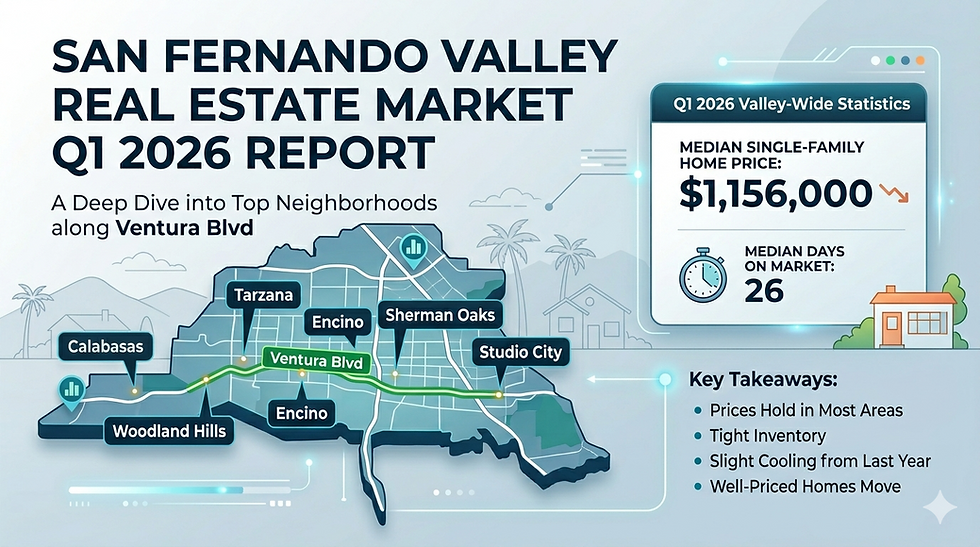
Quick Answer The San Fernando Valley real estate market in Q1 2026 showed a slight cooling from last year, with the median single-family home price across the Valley sitting at $1,156,000 and a median of 26 days on market. Prices held in most neighborhoods, inventory remained tight, and well-priced homes continued to move. The biggest disruption was a temporary buyer pause in early March following the outbreak of the U.S.-Israel conflict with Iran, but buyer activity has since rebounded heading into summer. |
Key Takeaways • The Valley closed 901 single-family home sales in Q1 2026 at a median price of $1,156,000 and an average sale-to-list ratio of 99.3%. • Across the broader CLAW/MLS footprint (Pacific Coast Highway to Downtown LA), the median single-family price dipped 2.66% year over year and closed sales dropped 4%. • A major Los Angeles escrow company reported a 30.4% weekly cancellation rate the week of March 2–6, aligning with market uncertainty from the Iran conflict that began February 28. • Tarzana held strong at $1,816,250 median despite slightly lower activity than Q1 2025, when rates were roughly half a percentage point higher. • Buyers who paused in March have returned. The spring market is active, and rates are sitting in the low-to-mid 6% range (6.37% as of May 7, 2026). |
Every quarter, I pull the numbers for the neighborhoods I work in across the San Fernando Valley and the Westside because the data tells a story that headlines miss. Q1 2026 told a clear one: the San Fernando Valley real estate market in 2026 is not crashing, it is not booming, and it is not frozen. It is moving with purpose, rewarding preparation, and punishing guesswork.
The numbers showed strength in most of my core neighborhoods, from Tarzana to Sherman Oaks to Woodland Hills. But Q1 also brought something nobody planned for. When the U.S.-Israel military conflict with Iran began on February 28, the market flinched. Buyers paused. Escrow cancellations spiked. And for a few weeks, the phones got quieter. That pause was real, but it was also temporary. By April, buyer activity was picking back up, and heading into late May, the market feels engaged again.
Here is what the data shows, what I am seeing on the ground, and what it means if you are thinking about buying or selling this year.
What Did Q1 2026 Look Like Across the Valley?
The Valley closed 901 single-family home sales in Q1 2026 with a median price of $1,156,000 and a median of 26 days on market. The average sale-to-list ratio came in at 99.3%, which tells you that buyers were paying very close to asking for homes that were priced correctly and showed well.
Zooming out to the broader CLAW/MLS footprint (the area stretching from Pacific Coast Highway to Downtown Los Angeles), the picture showed a slight pullback. The median single-family price dipped 2.66% compared to Q1 2025, total sales volume fell 10.45%, and the number of closed sales was down 4%. Condos and co-ops told a similar story, with median prices down 5.21% and sold listings down 5.48%.
Those are not alarming numbers. They reflect a market that cooled slightly from last year's pace, partly due to economic uncertainty and partly because the conflict in Iran disrupted buyer confidence in early March.
What Happened to the Market When the Iran Conflict Started?
This is the part that does not show up in a median price chart. On February 28, the U.S. and Israel launched military strikes against Iran. Within days, the real estate market in Los Angeles felt it. A major Los Angeles escrow company reported that their weekly cancellation rate hit 30.4% the week of March 2 through 6. That is well above normal.
I saw it in my own business. Buyers who had been active pulled back. Showings slowed. People who were ready to write offers decided to wait and see. It was not panic, but it was caution. When a conflict of that scale breaks out and gas prices start climbing, people get careful with big financial decisions. That is a reasonable response.
The good news: it did not last. By mid-April, buyers started returning, and heading into late May the market feels more engaged than it did in March. A conditional ceasefire was declared on April 8, which helped settle some of the uncertainty. Rates have also stayed in the low-to-mid 6% range (the 30-year fixed averaged 6.37% as of May 7, according to Freddie Mac), which is meaningfully better than the 6.8% to 7% range buyers were facing at this time last year.
How Did Key San Fernando Valley Neighborhoods Perform in Q1 2026?
The Valley is not one market. It is a collection of neighborhoods with different price ceilings, buyer pools, and inventory levels. Here is how the neighborhoods I work in most closely performed in Q1:
Neighborhood | Closed Sales | Median Price | $/SqFt | Median DOM | SP/LP Ratio | YoY Price Change |
Studio City | 53 | $2,260,000 | $847 | 30 | 95.0% | -1% |
Calabasas | 47 | $1,850,000 | $759 | 37 | 96.1% | -30% |
Tarzana | 40 | $1,816,250 | $626 | 26 | 95.2% | 0% |
Encino | 63 | $1,783,943 | $751 | 33 | 97.4% | -20% |
Sherman Oaks | 91 | $1,710,000 | $822 | 27 | 95.9% | -3% |
Woodland Hills | 112 | $1,450,000 | $612 | 22 | 97.8% | 3% |
Source: MLS closed sales data, Q1 2026. Year-over-year change reflects median price comparison to Q1 2025 per CLAW/TheMLS.
Studio City led the Valley at $2,260,000. That number is higher than it might look at first glance because new construction has been a real driver in Studio City lately. Several newly built homes sold at significant numbers in Q1, pulling the median up. If you strip those out, the resale market is still strong but not quite at that level.
Tarzana came in at $1,816,250 with 40 closed sales and a 26-day median. A couple of things worth noting: the combined Tarzana number includes everything north and south of Ventura Boulevard. South-of-Ventura prices ran higher than this combined figure. And activity was slightly behind Q1 2025 levels, despite the fact that rates were roughly half a percentage point higher a year ago. Considering everything, Tarzana held strong.
Woodland Hills led the Valley in transaction volume with 112 closed sales and the fastest median days on market at 22. At $1,450,000 median, Woodland Hills offers relative value compared to its east-of-Topanga neighbors and continues to attract serious buyer attention.
Sherman Oaks posted 91 sales at $1,710,000 with a striking $822 per square foot, the second highest in the Valley behind Studio City. That price-per-foot number reflects the ongoing demand for Sherman Oaks' central location, walkable stretches of Ventura, and neighborhood identity.
For buyers exploring more affordable entry points, Northridge ($987,000 median, 16 days on market, 100.1% SP/LP), Van Nuys ($880,000, 20 days), and Reseda ($825,000, 27 days) all showed strong demand at lower price points. Those are competitive pockets where good homes move fast.
What Does This Mean for Buyers and Sellers Right Now?
For Sellers
If you are thinking about listing, the data supports doing it soon. Spring and early summer remain the strongest seasonal window, and buyer activity is recovering from the March pause. But the Q1 numbers also send a clear message: pricing precision matters more than ever. The average SP/LP of 99.3% means buyers are paying close to asking for homes that are priced right and show well. Homes that launch at aspirational numbers sit longer, attract fewer offers, and lose momentum. The first two weeks on market are when you have the most leverage. Start right.
For Buyers
Rates are lower than they were a year ago. The 30-year fixed is sitting around 6.37% compared to 6.76% at this time in 2025. That is not a dramatic difference in monthly payment, but it matters. More importantly, the brief pause in March created a pocket of opportunity. Some buyers stepped back, and those who stayed in the market faced slightly less competition. That window may be narrowing as more buyers return for summer, so if you are pre-approved and serious, this is a good time to be looking.
The entry-level and mid-tier segments remain competitive. If you are looking in the sub-$1.5M range in the Valley, expect to move quickly when a well-priced home hits the market. In the upper-end pockets (Studio City, Encino, Calabasas), there is more room to negotiate and more time to make decisions.
San Fernando Valley Real Estate Market FAQ
What is the median home price in the San Fernando Valley in 2026?
The median closed price for single-family homes across the San Fernando Valley in Q1 2026 was $1,156,000. Prices vary significantly by neighborhood, ranging from $745,000 in Panorama City to $2,260,000 in Studio City. Across the broader CLAW/MLS area, the median dipped 2.66% compared to the same quarter last year.
How fast are homes selling in the San Fernando Valley?
The median days on market for Valley single-family homes was 26 in Q1 2026. Woodland Hills was among the fastest at 22 days, while luxury-leaning neighborhoods like Calabasas (37 days) and Encino (33 days) gave buyers more time. Well-priced homes in the sub-$1.5M range consistently moved within a month.
Did the Iran conflict affect the Los Angeles housing market?
Yes, temporarily. A major Los Angeles escrow company reported a weekly cancellation rate of 30.4% the week of March 2 through 6, shortly after the conflict began on February 28. Buyer activity slowed for several weeks but rebounded by mid-April, helped by a conditional ceasefire on April 8 and rates that stayed in the low-to-mid 6% range.
Is the San Fernando Valley a buyer's or seller's market in 2026?
Most Valley neighborhoods lean seller-to-balanced as of Q1 2026. The average sale-to-list ratio of 99.3% favors sellers who price accurately, while the 26-day median DOM gives buyers a workable decision window. Luxury segments offer more negotiating room than entry-level and move-up price points.
Thinking about buying or selling in the San Fernando Valley or on the Westside? I would love to hear from you. Call or text me at 310-739-9202, or email Leegie@Leegie.com. I will give you a thoughtful, grounded take on where you stand and what the data means for your specific situation.
Leegie Parker
Real Estate Advisor, Compass
DRE 01020534
310-739-9202 | Leegie@Leegie.com | Leegie.com


Comments